Showing posts with label education. Show all posts

Friday, December 2, 2011

Unemployment Paranoia: Job Market Report

When I was a senior at BU preparing to graduate in 2009 (arguably one of the worst years to graduate from college in the last few decades), for some strange reason I was not very worried about getting a job, at least that's how I remember it. I was either too optimistic, too confident, or I just didn't pay much attention to the doomsday headlines at the time.

Now that I am a few years older (and presumably wiser?), the job market is actually starting to worry me some. With student loan interest from undergrad accumulating on me while I am in graduate, I can hear the clock ticking on me.

I've heard a variety of things about current job market conditions, but it seems to me the underlying feeling that most people have is that the job market is tougher than ever and options are slimmer than ever. People are taking second tier or part-time jobs until better positions open up elsewhere. Throngs of recent college grads are moving in with their parents. Here are some more doom and gloom unemployment stories if you really want to get depressed.

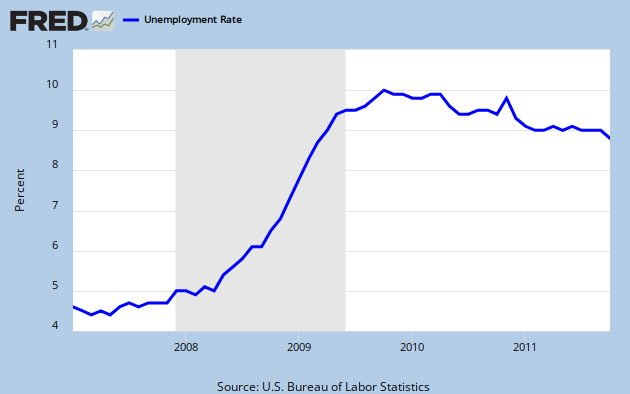
Is my new-found paranoia about unemployment rational? Let's take a look at the data. The graph below, and several others I have posted in the past (here and here), are quite worrisome.


Although the outlook is pretty bad for a lot of people right now, there are small signs of life in the labor market. The unemployment rate has been slowly ticking down since early the late 2009 / early 2010.

Job quits are also continuing to rise. Yes, more people quitting their jobs is actually a good thing. Rising job quits are typically associated with recoveries. People leaving a job may have done so because they feel confident about their other job options. This can be thought of as a signal that people are expecting more hiring in the labor market. Obviously high turnover can be bad for a particular company or organization, but in an economy, some amount of turnover is necessary so that labor markets can effectively match people with jobs that best use their skills.


The best news of all, it is well established that, on average, people with a college education or higher fare better in the labor market than those with less education. Although unemployment rates are up across the board, the unemployment rate for people with a bachelor's degree and higher is about 4% compared to 14% for people without a high school diploma. This is a always reassuring, even if the relationship isn't completely causal.

*2011 unemployment rate through November 10th, 2011
For more positive news about the most recent jobs numbers, I just found this jobs report from CNN. Things are looking up.

Wednesday, November 30, 2011

Charter School Growth

Yesterday, I wrote about some key questions facing the charter school movement. I starting thinking about how important these questions are in terms of the structure of our public education system. Here is what I dug up.


Data for 2009-2010 and 2010-2011 were unavailable. The percentage of total schools that are classified as charter schools is increasing by about .29% per year. This means that in 2011-2012, charters are projected to be about 5.63% of all operational schools (assuming a linear trend). This is a relatively small proportion of the total, but certainly more than just a drop in the bucket. And this proportion is growing larger each year.

 
In fact, charter schools have more than doubled since 2000, whereas the total number of operational schools has grown by about 10% over the same time frame. This impressive growth shows that charter schools have gained traction. Serious work needs to be done to analyze the charter model and how it can successfully be scaled up.

Data sources:
*Source: Table 100. Number and enrollment of public elementary and secondary schools, by school type, level, and charter and magnet status: Selected years, 1990-91 through 2008-09
http://nces.ed.gov/programs/digest/d10/tables/dt10_100.asp

**Source: NCES Common Core of Data (CCD), "Public Elementary/Secondary School Universe Survey"
http://nces.ed.gov/ccd/bat/

Tuesday, November 29, 2011

Questions about Charter Schools

A teacher friend recently sent me an Economist piece from 2009 about charter schools. Several extremely successful charters such as KIPP and Uncommon Schools have received a lot of press. However, the jury is still out on charter schools as a whole as much of the research is mixed about their overall impact. Below are two particularly relevant questions about charter schools that I believe are still unanswered today.
If charter schools are teaching a narrow curriculum and focusing on test preparation, that should become clear when data are gathered on high-school completion rates and college destinations. If they are excluding lots of pupils, that will be obvious too. And if the state education department co-operates by giving researchers access to data on its own pupils, it will be possible to tell whether charter schools are leaching talent from state schools—or whether the challenge they pose to incumbents improves performance across the board.
[...] The final charge against schools such as those run by KIPP is that their longer hours and the demands those place on teachers make them impossible to sustain, let alone replicate.
I am not proposing that I know the answers to these questions. I am simply recognizing that the area needs more research along with more time to follow the outcomes of the growing cohorts of "charter students".

Wednesday, November 16, 2011

Tennessee Teachers Get to Play the Odds in the Evaluation Game

I will preface this post for anyone that is not aware. I taught high school math in Nashville, Tennessee for the last two years in the public school system. 

Tennessee is implementing a new teacher evaluation system this year. A NY Times article titled In Tennessee, Following the Rules for Evaluations Off a Cliff discusses the shortfalls of the new teacher evaluation system. I am aware of the challenge of measuring student achievement in classes like art, band, dance, and other subjects that don't have state tests, but this part surprised me:
For 15 percent of their testing evaluation, teachers without [test] scores are permitted to choose which subject test they want to be judged on. Few pick something related to their expertise; instead, they try to anticipate the subject that their school is likely to score well on in the state exams next spring. 
And more...
It’s a bit like Vegas, and if you pick the wrong academic subject, you lose and get a bad evaluation. While this may have nothing to do with academic performance, it does measure a teacher’s ability to play the odds. 
Although a learning curve is to be expected for states implementing new evaluation systems, allowing teachers of non-tested subjects choose which subject test they will be judged on is just a horrible idea. This blatantly bad policy needs to be scrapped, and the state department needs to go back to the drawing board. Why evaluate teachers on how their students do in ANOTHER subject? They have less incentive to teach THEIR subject well.

Sidenote: I am glad I'm not teaching right now in TN.

HT M.S.

Friday, October 28, 2011

Forgiving Student Loan Debt - A Good Or Bad Idea?

This idea has been floating around the internet for a couple of months. My thoughts? One of the worst ideas ever. Although I have a pile of student loans myself, and I would benefit greatly from a policy like this, I can see how inane this idea actually is. Here is Justin Wolfers on why this idea sucks.


Addendum: I found this piece from the Economist discussing student loan forgiveness.
Many of the anti-Wall Street protesters push the idea of blanket debt forgiveness as a solution. But that is the wrong answer. Higher education is not a guarantee of employment, but it improves the odds immensely. Unemployment rates among university graduates stood at 4.4% on average across OECD countries in 2009. People who did not complete secondary school faced unemployment rates of 11.5%. Much of the debt that students are taking on is provided or guaranteed by the government. Imposing write-offs on all taxpayers to benefit those with the best job prospects is unfair; and ripping up contracts between borrowers and private lenders is usually a bad idea.
I could not agree more. The article goes on to discuss why student loan laws need to be changed in order to ease the burden of student loans in times of economic crisis.

Thursday, October 13, 2011

The State of India's Educational Attainment

The excerpts below are from a paper by economists Barry Bosworth and Susan Collins when they were both research fellows at the Brookings Institution a few years ago (Bosworth is still there).
[...] 98 percent of China’s primary school enrollees reach the fifth grade, compared to 60 percent for India. Despite an external reputation for having a large pool of highly educated persons, India faces serious deficiencies in the education of the bulk of its youth population (p. 63).
Before reading this article, my perceptions of India matched the "external reputation" described above. However, the data do not lie. The following table from the paper (p.52) compares India to their "peer group."


India clearly started the race a few strides back in 1960, and they still have a lot of ground to make up moving forward. While average years of schooling increased, and the share of their population without schooling decreased significantly, India still had almost 3 times as much of their population with no schooling relative to China. The authors also cite a literacy rate of just 76% among youth aged 15-24 in India compared to a 99% literacy rate for China (p.52).

Taking the state of India's education as given, the authors suggest the following.
Ultimately, India will need to redress its inadequate infrastructure and to broaden its trade beyond the current emphasis on services. Only an expansion of goods production and trade can provide employment opportunities for its current pool of underemployed and undereducated workers (p. 64).
The moral of the story? India needs to utilize it's workforce better in the short to medium run given where they currently stand. They can do this by ramping up industrial production and trade, a traditional source of growth for developing nations.

Over the long run, education is key. In the race to educate, India still has some catching up to do. If they can accelerate the rate of progress they have made in education over the last 40 years, then economic growth will be sustainable for years to come.

Wednesday, October 5, 2011

1800's Harvard Exam

This old-school Harvard exam from the 1800s would have rocked my socks. Lot's of Latin and computational math problems. At first glance, I thought the word "rod" was a typo (arithmetic, question 6). Then I looked it up. Apparently, 1 square rod = 30.25 square yards. I guess they stopped teaching that measurement in school.

Click the picture to access the exam

HT Mitchell for sharing this.